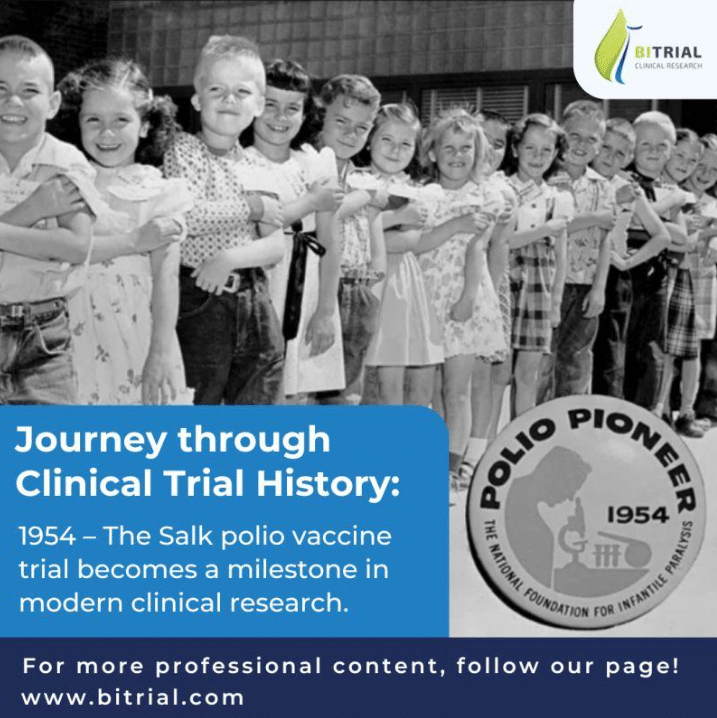
We continue our series on the milestones of clinical research. The next important year is 1954, when one of the largest and most important modern randomized controlled trials (RCTs) in history was conducted: the field trial of the Salk polio vaccine. 💉😷
Although the first medical RCT is often considered to be the 1948 streptomycin trial conducted by the British Medical Council (MRC), the 1954 polio trial made this methodology widely known worldwide and established it as the “gold standard” of clinical research.
🔑 Key characteristics of the 1954 Salk vaccine trial
🎯 Objective: To demonstrate the safety and effectiveness of the inactivated virus vaccine developed by Jonas Salk.
📈 Scale: It was the largest public health experiment conducted up to that time. In total, approximately 1.8 million children participated across the United States, who were known as the Polio Pioneers.
📋 Methodology: The trial was led by Thomas Francis Jr. at the University of Michigan. A strict double-blind, placebo-controlled design was used for a large portion of the participants.
🚀 Results: The report published in 1955 confirmed that the vaccine was 60–90% effective against poliomyelitis, leading to the immediate launch of mass vaccination programs.
Why was this considered a “modern” RCT?
🎲 Randomization: Participants were randomly assigned to vaccine and control groups to avoid bias.
💉 Control group and placebo: Members of the control group received an inert saline solution, making it possible to measure the true effect of the vaccine.
⚖️ Double-blinding: Neither the children (or their parents) nor the physicians administering the injections knew who received the actual vaccine and who received the placebo.
🤝 At BiTrial, we are committed to advancing medical science and supporting innovation in healthcare. Every day, we work to contribute to the success of modern clinical research and help bring new therapies closer to patients.
If you would like to learn more about BiTrial’s services, contact us!
